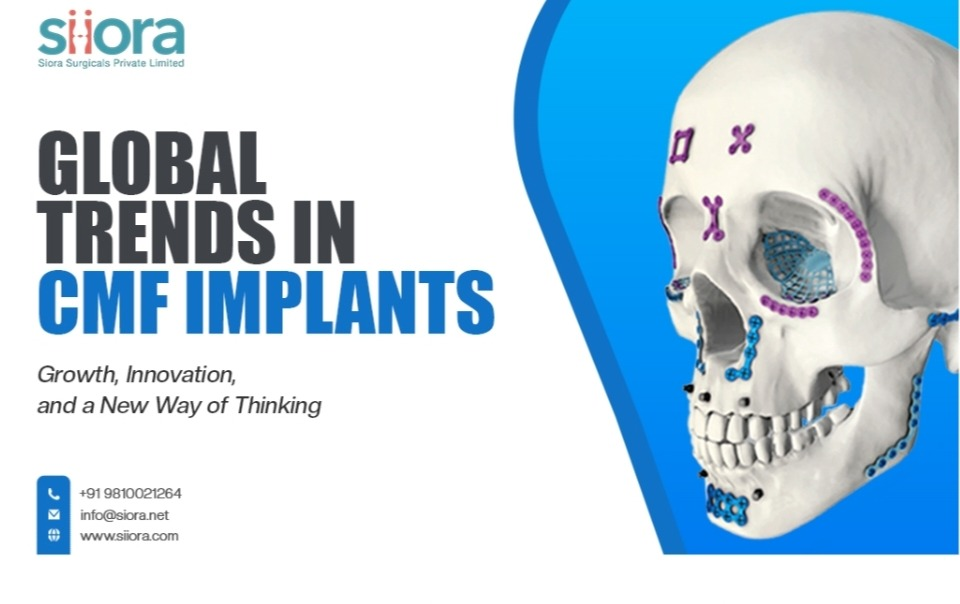
Cranio-maxillofacial (CMF) surgery has changed more in the last twenty years than in the entire century before it. What once relied on simple, rigid plates has evolved into a science of precision, where implants are built to fit real people — not just textbook anatomy. Surgeons today don’t want tools that merely hold a fracture together; they’re looking for systems that move with the patient’s biology, encourage faster bone healing, and make every procedure just a little safer.
This shift in surgical philosophy is clearly visible in the way hospitals, manufacturers, and entire markets are thinking about CMF implants.
A Market on the Move
The demand for CMF implants isn’t surprising when you look at what’s happening around the world. Road accidents, sports trauma, and even urban violence push up the number of facial injuries each year. On the other hand, older adults with weaker or osteoporotic bones now represent a larger share of surgical patients. Both ends of the spectrum are fueling demand for better fixation systems.
North America and Europe have already embraced advanced CMF technologies, but the real acceleration is happening elsewhere. Throughout Asia-Pacific, the Middle East, and Latin America, hospitals are investing heavily in newer implant systems. As healthcare infrastructure catches up and more specialists are trained, the gap between “developed” and “emerging” markets is closing quickly.
Beyond Fixation: Healing as a Design Goal
Modern CMF implant design isn’t about hardware anymore; it’s about harmony. Newer materials like titanium alloys and hybrid composites combine durability with lightweight flexibility, while surface coatings actively encourage bone integration. The addition of variable-angle screws and pre-contoured, low-profile plates means surgeons spend less time bending metal and more time ensuring perfect alignment. Those small improvements lead to real gains in recovery speed and patient confidence.
How Technology Is Rewriting Surgery?
Digital planning has arguably changed this field more than any single innovation. Detailed imaging, 3D simulations, and custom-printed implant guides allow surgeons to plan reconstructions before stepping into the operating theatre. What used to depend on experience and adjustments “on the fly” is now mapped digitally — almost like rehearsing the entire procedure beforehand.
Even smaller hospitals are starting to adopt 3D printing for personalized implants. These aren’t futuristic concepts anymore; they’re becoming normal practice. The outcome? Shorter surgeries, more accurate screw placement, and far fewer post-op revisions.
Faster Surgeries, Smoother Recovery
New implant systems also make recovery gentler for patients. Because these devices are designed to fit precisely, doctors can take smaller incisions and preserve soft tissue. That means less pain, reduced swelling, and a noticeably faster return to normal life. For hospitals, this translates into fewer readmissions and higher patient satisfaction — the twin currencies of modern healthcare.
Looking Forward
The global CMF trauma implant market is expanding steadily and intelligently. The next wave of progress will most likely come from collaboration — surgeons working hand in hand with engineers and digital planners to create smarter, integrated systems. As materials evolve and software gets more advanced, surgery itself becomes less about correction and more about restoration.
What once defined the field — metal plates and rigid screws — is quickly giving way to something far more human: implants built not just to hold bones together, but to help people heal better and live fully.